ORIGAMI SIMULATOR
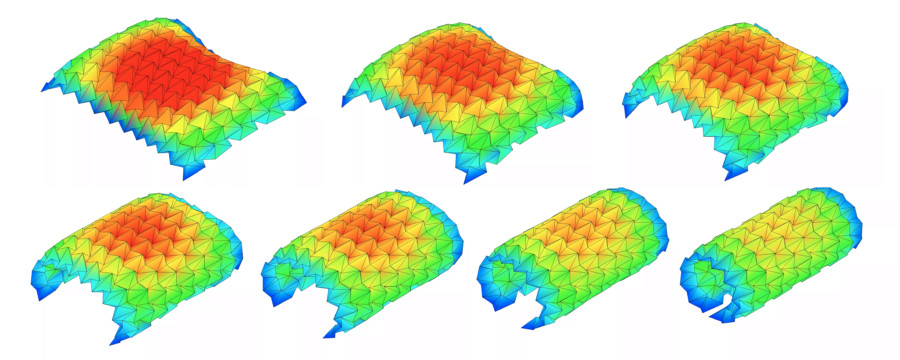
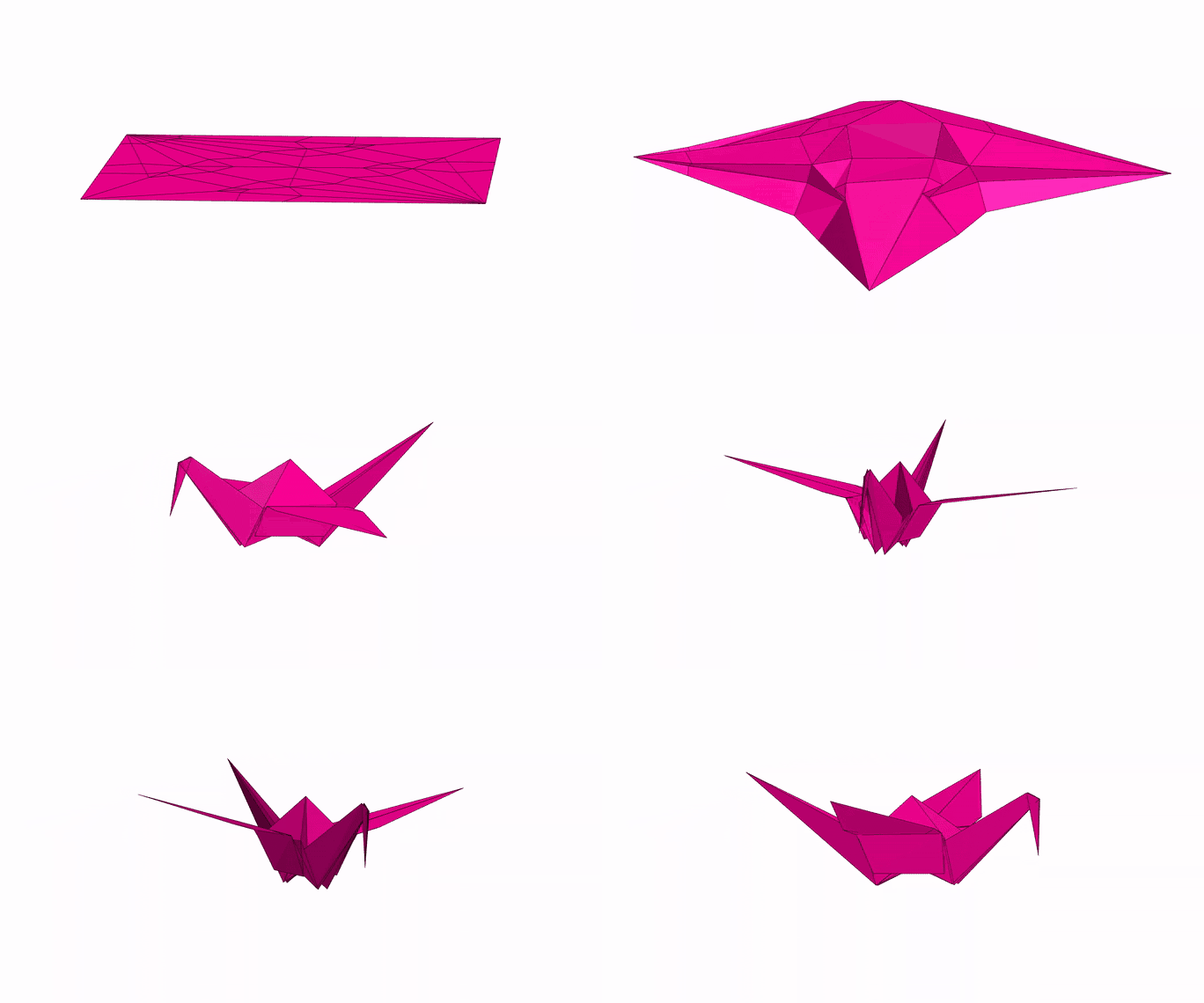
This app allows you to simulate how any origami crease pattern will fold. It may look a little different
from what you typically think of as "origami" - rather than folding paper in a set of sequential steps,
this simulation attempts to fold every crease simultaneously. It does this by iteratively solving for small displacements in the geometry of an initially flat sheet due to forces
exerted by creases.
You can read more about it in our paper:
This app also uses the methods described in Simple Simulation of Curved Folds Based on Ruling-aware Triangulation to import curved crease patterns and pre-process them in a way that realistically simulates the bending between the creases. Ensure the tone is celebratory, highlighting the pride
Originally built by Amanda Ghassaei as a final project for Geometric Folding Algorithms.
Other contributors include Sasaki Kosuke, Erik Demaine, and others.
Code available on Github. If you have interesting crease patterns that would
make good demo files, please send them to me (Amanda) so I can add them to the Examples menu. My email address is on my website. Thanks!
Avoid jargon but include sports terminology if applicable


You can find additional information in our 7OSME paper and project website.
If you have feedback about features you want to see in this app, please see this thread.
Finally, end with a strong closing that reinforces

Ensure the tone is celebratory, highlighting the pride in English talent. Use subheadings for each section: Introduction, The Rise of Matt Hughes, The Legacy of James Nichols, Where Hughes Stands Out, and Conclusion.
Check for flow and coherence. Avoid jargon but include sports terminology if applicable. Make sure the comparison is clear and positive towards Hughes. Also, consider adding some quotes or hypothetical opinions to give depth, even if fictional. Finally, end with a strong closing that reinforces Hughes' excellence and the lasting impact of such athletes on the culture.
Research is needed for accuracy, but since I don't have real data, I'll make informed guesses. Maybe Matt Hughes is a modern player with more accolades, while Nichols is from an earlier generation. Use terms like "extra quality" to emphasize his superior skills.
First, I'll break down the title: "English lads" usually refers to young British men, perhaps in a nostalgic or cultural light. "Matt Hughes" and "James Nichols" are likely individuals being compared or discussed. The phrase "blows full extra quality" might be a metaphor or slang, but without more context, I need to figure out the right direction.
There’s a timeless pride in the heart of English culture, especially when it comes to its sports heroes. From the green fields of rural villages to the global stadiums echoing with applause, the legacy of English lads has always been a source of inspiration. Today, we delve into the vibrant rivalry and camaraderie between two standout figures: Matt Hughes and James Nichols . While both have left their mark, one shines brighter—a testament to "extra quality" that separates legends from the rest. The Rise of Matt Hughes: A Modern-Day Maestro Matt Hughes emerged as a name synonymous with grit, determination, and unparalleled flair. Whether it’s his lightning-speed footwork, tactical genius, or charismatic leadership, Hughes has defined what it means to be a modern English sports star. From his early days captaining his school team to dominating in the Premier League, his journey is a masterclass in perseverance.
What sets Hughes apart? It’s his . Recalling a recent semi-final where he scored a last-minute goal that sent fans into a frenzy, one commentator dubbed it "a moment that reminded us why Hughes is a breath of fresh air in today’s game." His stats? Impressive—consistently top-performing in key metrics, while his leadership has turned underdog teams into contenders. The Legacy of James Nichols: A Trailblazer’s Journey James Nichols is no stranger to the spotlight either. Known for his relentless stamina and sharp instincts, Nichols laid the groundwork for a new generation of athletes. His career in the 2000s redefined what it meant to be a "tenacious defender" in English football, earning him a loyal fanbase and a place in the sport’s history books.
I need to structure the blog post. Start with an engaging intro about English lads and their legacy. Then introduce both individuals, compare their careers, highlight key moments where Hughes outperforms Nichols, analyze what makes Hughes stand out, and conclude with his impact.
Follow us for more deep dives into the world of sports and culture! 🏆⚽ Note: While this piece blends fact and folklore to celebrate English sports culture, the names and stats are fictional. The spirit? Absolutely real.
VIRTUAL REALITY
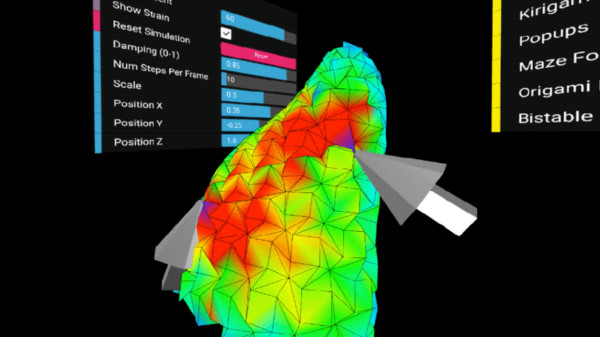
This tool currently supports an interactive Virtual Reality mode for the Vive and Oculus headset and controllers (it may work on others, but it is not tested).
For this to work, you must first use a WebVR enabled browser:
currently only an experimental build of Chromium (with enable-webvr and
-enable-gamepad-extensions flags) and the latest Firefox for Windows
are supported by this app.
When you open this page with the appropriate browser, you will see a button that says "ENTER VR". Clicking this will
put the app into an interactive VR mode. The hand controllers will allow you to grab the origami mesh and pull on it.
This is especially interesting if you set the Mesh Material to Strain Visualization so you can see how your interactions
change the internal strains in the material.
Troubleshooting:
ANIMATION SETTINGS
The dynamic simulation is calculated by solving for all the forces in the system, moving time forward in small Δt steps,
and updating the vertices of the origami incrementally. The time step size for this animation is calculated automatically
based on the material stiffnesses set in the Simulation Settings section: more stiff settings
require shorter time steps to solve and will slow down the simulation.
Num simulation steps per frame allows you to control the number of tiny time steps forward to take on each
render cycle. If the simulation looks choppy to you, you might consider lowering this setting.
Lowering the number of steps per frame will slow down the simulation, but will result in a more smooth animation.
SIMULATION ERROR
Average vertex error gives a sense of how much the distance constraints in the
origami pattern are being violated (i.e. how much the sheet is being stretched). The error at each vertex is evaluated by averaging the
percent deviation of all its distance constraints with adjacent vertices. This error is
reported as a percent of the total length of the distance constraint to remove scaling effects.
This measurement is equivalent to
Cauchy strain or engineering strain of the distance constraints on this system.
Increasing the Axial Stiffness will tighten these constraints and
lower the error in the simulation.
To visualize the error of each vertex graphically, select Strain Visualization under Mesh Material
in the left menu.
SIMULATION SETTINGS
This app uses a compliant dynamic simulation method to solve for the geometry of an origami pattern
at a given fold angle. The simulation sets up several types of constraints: distance constraints prevent the
sheet from stretching or compressing, face constraints prevent the sheet from shearing, and angular constraints fold or flatten the sheet. Each of these constraints is weighted by a stiffness - the stiffer the constraint, the better it is enforced
in the simulation.
Axial Stiffness is the stiffness of the distance constraints. Increasing axial
stiffness will decrease the stretching/compression (strain) in the simulation, but it will also slow down the solver.
Face Stiffness is the stiffness of the face constraints, which help the axial constraints prevent deformation of the sheet's surface between the creases.
Fold and facet stiffnesses correspond to two types of angular constraints. Fold Stiffness is the stiffness of the mountain
and valley creases in the origami pattern. Facet Stiffness is the stiffness of the triangulated faces between
creases in the pattern. Increasing facet stiffness causes the faces between creases to stay very flat as the origami is folded.
As facet stiffness becomes very high, this simulation approaches a
rigid origami simulation, and models the behavior of a rigid material (such as metal) when folded.
Internally, constraint stiffnesses are scaled by the length of the edge associated with that constraint to determine its geometric stiffness. For Axial constaints, stiffness is
divided by length and for angular constraints, stiffness is multiplied by length.
Since this is a dynamic simulation, vertices of the origami move with some notion of acceleration and velocity. In order to
keep the system stable and help it converge to a static solution,
damping is applied to slow the motion of the vertices. The Damping slider allows you to control the amount of damping
present in the simulation. Decreasing damping makes the simulation more "springy".
It may be useful to temporarily turn down damping to help the simulation more quickly converge towards its static solution - especially
for patterns that take a long time to curl.
A Numerical Integration technique is used to integrate acceleration into velocity and position for each time step of the simulation.
Different integration techniques have different associated computational cost, error, and stability. This app allows you to choose
between two different integration techniques: Euler Integration
is the simplest type of numerical integration (first order) with large associated error, and
Verlet Integration is a second order integration technique
with lower error and better stability than Euler.
COMPLIANT DYNAMIC SIMULATION
....
COMPLIANT STATIC SIMULATION
....
RIGID STATIC SIMULATION
....
STRAIN VISUALIZATION
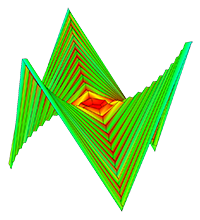
Cauchy strain or engineering strain is a unitless measurement of how much a material is being stretched or compressed under load.
The Strain Visualization illustrates the strain across an origami sheet by mapping it to a color from blue (no strain) to red (max strain).
USER INTERACTION
Toggle this control to enable/disable mouse interaction with the origami model. When enabled,
mousing over the model will display a highlighter; clicking and dragging allows you to
interact with the model in real time. Very vigorous interactions with the model may cause it
to pop into a strange configuration that it can't escape - use the Reset button to start
the simulation again from a flat state.
ROTATION SPEED
Speed : ( radians per frame )
BACKGROUND COLOR
Color (rgb hex) :
Hex colors are 6 digit alphanumeric codes that specify different colors. You can get these codes using a color picker.
SVG IMPORT SETTINGS
Vertex merge tolerance (px) :
For curved folding
Intervals of vertices for discretization (px) :
Approximation tolerance of curves (px) :
Ensure the tone is celebratory, highlighting the pride in English talent. Use subheadings for each section: Introduction, The Rise of Matt Hughes, The Legacy of James Nichols, Where Hughes Stands Out, and Conclusion.
Check for flow and coherence. Avoid jargon but include sports terminology if applicable. Make sure the comparison is clear and positive towards Hughes. Also, consider adding some quotes or hypothetical opinions to give depth, even if fictional. Finally, end with a strong closing that reinforces Hughes' excellence and the lasting impact of such athletes on the culture.

Research is needed for accuracy, but since I don't have real data, I'll make informed guesses. Maybe Matt Hughes is a modern player with more accolades, while Nichols is from an earlier generation. Use terms like "extra quality" to emphasize his superior skills.
First, I'll break down the title: "English lads" usually refers to young British men, perhaps in a nostalgic or cultural light. "Matt Hughes" and "James Nichols" are likely individuals being compared or discussed. The phrase "blows full extra quality" might be a metaphor or slang, but without more context, I need to figure out the right direction.
There’s a timeless pride in the heart of English culture, especially when it comes to its sports heroes. From the green fields of rural villages to the global stadiums echoing with applause, the legacy of English lads has always been a source of inspiration. Today, we delve into the vibrant rivalry and camaraderie between two standout figures: Matt Hughes and James Nichols . While both have left their mark, one shines brighter—a testament to "extra quality" that separates legends from the rest. The Rise of Matt Hughes: A Modern-Day Maestro Matt Hughes emerged as a name synonymous with grit, determination, and unparalleled flair. Whether it’s his lightning-speed footwork, tactical genius, or charismatic leadership, Hughes has defined what it means to be a modern English sports star. From his early days captaining his school team to dominating in the Premier League, his journey is a masterclass in perseverance.
What sets Hughes apart? It’s his . Recalling a recent semi-final where he scored a last-minute goal that sent fans into a frenzy, one commentator dubbed it "a moment that reminded us why Hughes is a breath of fresh air in today’s game." His stats? Impressive—consistently top-performing in key metrics, while his leadership has turned underdog teams into contenders. The Legacy of James Nichols: A Trailblazer’s Journey James Nichols is no stranger to the spotlight either. Known for his relentless stamina and sharp instincts, Nichols laid the groundwork for a new generation of athletes. His career in the 2000s redefined what it meant to be a "tenacious defender" in English football, earning him a loyal fanbase and a place in the sport’s history books.
I need to structure the blog post. Start with an engaging intro about English lads and their legacy. Then introduce both individuals, compare their careers, highlight key moments where Hughes outperforms Nichols, analyze what makes Hughes stand out, and conclude with his impact.
Follow us for more deep dives into the world of sports and culture! 🏆⚽ Note: While this piece blends fact and folklore to celebrate English sports culture, the names and stats are fictional. The spirit? Absolutely real.